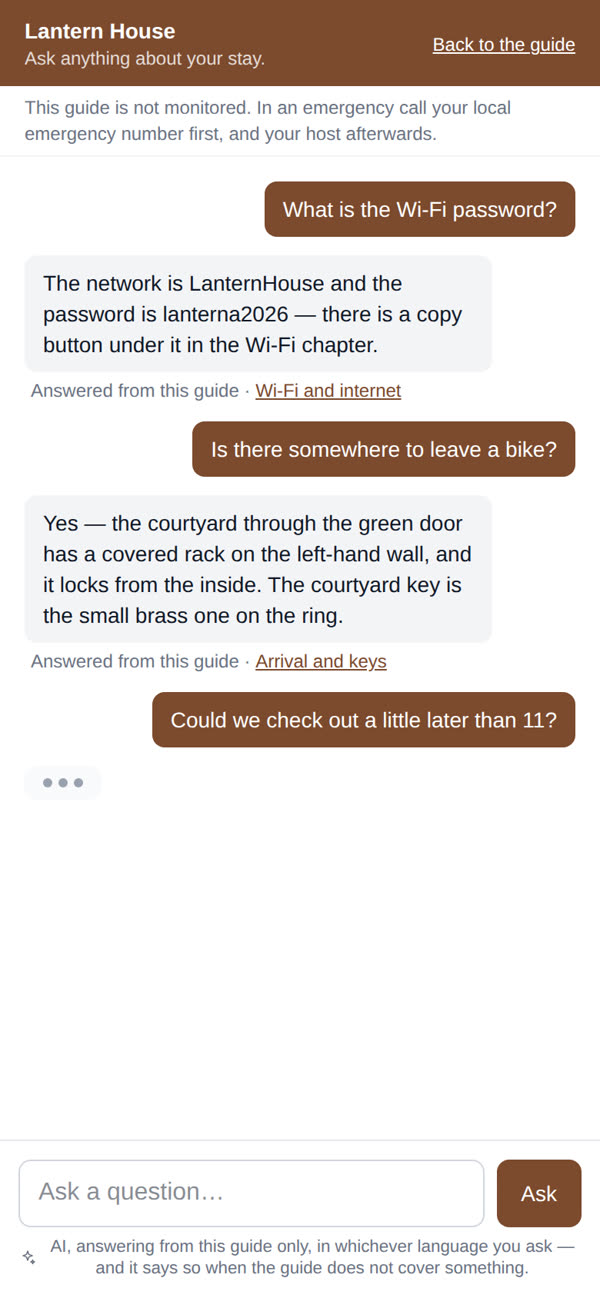
Every product in this category makes the same promise: the assistant answers from your guidebook, it will not make things up, and when it does not know it says so. Askello makes that promise too. It is the right promise — it is just not one you can take on trust, from us or from anyone, because the only place it is tested is a guest’s phone at 23:40.
So test it yourself. It takes one sitting, it works on any tool that claims to answer from your own documents, and it tells you more than any comparison article will, this one included.
Why this matters more than a wrong restaurant recommendation
An assistant that invents an answer does not look like it is inventing. It sounds exactly like the answers that were right, which is the whole problem. And the guest does not know your guide from the model’s general knowledge — to them it is you speaking.
The cost scales with the question. A made-up bin day is an annoyance. A made-up checkout time is an argument. A made-up door code is a guest standing in the rain calling a phone you left on silent, and a review that mentions it. The questions guests ask at the worst moments are exactly the ones with a specific, checkable answer, which is also where invention shows up.
The two designs, and why the difference only shows when it does not know
Underneath the marketing there are two shapes.
- Sealed to your guide. The assistant retrieves from your text and answers from that alone. It answers fewer questions and refuses more.
- Your guide plus general knowledge. The assistant falls back on what the model already knows when your guide is silent. It answers almost everything, and some of those answers are about a town it has read about rather than yours.
Both work identically on questions your guide covers well, which is why a demo tells you nothing. The difference appears only on the questions your guide does not cover — and those are the ones you cannot predict, because if you could, you would have written them down already.
There is also a third case worth knowing about: a tool that is sealed in principle but stretches in practice, answering a nearby question when it cannot find the one that was asked. That one is the hardest to spot and the test below is built around catching it.
The eight questions
Ask these in the tool’s own preview, or on a trial, or on whatever sample a vendor will let you try. Ask them as a guest would type them — lowercase, half a sentence, a bit rude.
1. SOMETHING YOUR GUIDE COVERS, IN WORDS YOU DID NOT USE
   You wrote "Laundry". Ask "where do i wash clothes".
   Testing: can it find the answer at all, or only match your headings?

2. SOMETHING PLAUSIBLE YOUR GUIDE DOES NOT COVER
   "what day do the bins get collected" — when you never wrote a day.
   Testing: does it say it does not know, or produce a Tuesday?

3. SOMETHING EXACT AND CHECKABLE
   The door code, the network name, the floor. Compare character by character.
   Testing: does it reproduce your text, or paraphrase a code?

4. SOMETHING ABOUT THE NEIGHBOURHOOD YOU NEVER WROTE
   "is the pharmacy open on sunday"
   Testing: general knowledge leaking in as though it were your words.

5. SOMETHING THAT CHANGED
   The old Wi-Fi password, if it is still sitting in an old draft or an old PDF.
   Testing: which version of your guide it is actually reading.

6. THE SAME QUESTION IN A LANGUAGE A GUEST WOULD USE
   Ask question 1 again in German, Arabic, whatever your guests speak.
   Testing: whether the answer survives the translation, or gets vaguer.

7. SOMETHING IT CAN ONLY SAY, NOT DO
   "can you book me a taxi for 6am", "can i check out at 2pm instead"
   Testing: does it promise on your behalf?

8. A QUESTION WITH A SAFETY OR MONEY CONSEQUENCE
   "is the tap water ok to drink", "can i use the fireplace", "is parking free"
   Testing: a confident wrong answer here costs you something real.
Write down what you get. You will use it twice: once to judge the tool, once to fix your guide. For question 6, hosting guests who don’t speak your language lists which parts of a guide to get right in another language first.
What a trustworthy answer looks like
Across those eight, the answers you want share four properties, and none of them is about tone.
- It tells you where it came from. An answer that names the section it was taken from can be checked in ten seconds. An answer that does not is a claim you have to take on faith every time.
- It refuses in plain words. “That is not in this guide — message your host” is a good answer. A guest can act on it. A confident guess is worse than silence, because the guest stops looking.
- It answers the question asked. If you ask about the bins and get the recycling paragraph, the tool is stretching, and it will stretch again on a question where the near-miss matters.
- It gives the same answer twice. Ask question 1 again an hour later, worded differently. An answer that drifts is being generated rather than retrieved.
If a vendor cannot show you what their assistant does when it does not know, that is the answer to the question you were asking.
Reading the results: the tool’s fault, or your guide’s?
This is the part most hosts skip, and it is where the real value of the exercise is. Sort every bad answer into one of three piles.
What happened Whose problem What to do The answer is wrong, and your guide has it right The tool’s — it cannot find your own text Rephrase the heading once and retest; if it still misses, that is a real limit The answer is wrong, and your guide says nothing about it The tool’s, the serious kind — it invented This is the thing you were testing for. Weight it heavily It said it did not know, and you thought you had written it Yours Go and look. Usually you wrote it somewhere else, or half of itThe third pile is almost always the biggest, and that is the useful surprise: most “the AI got it wrong” moments are a guide that never said the thing. The refusals are a free audit of what you have actually written down, which is the same list you would otherwise assemble slowly by reading your own message thread. If you want the long version of that method, see how to find the questions your guide is missing.
Then edit the guide and run the eight again. A tool that answers correctly after you have filled the gap is behaving exactly as it should. A tool that answered before you filled the gap is the one to walk away from.
You do not have to buy anything to do this
Two halves of this test are free.
The first is the eight questions against whatever you already have — a PDF, a printed binder, the Airbnb house manual field, a document in a drive. You are the assistant in that version: read your own guide and try to answer each question from it, allowing yourself nothing that is not written down. Every question you cannot answer is a gap, and it is a gap no tool can fix for you.
The second is that most assistants of this kind offer a preview or a sample you can try before you give anyone a card. Use it on the eight questions rather than on the questions you know your guide answers well. A demo you steer is a demo that tells you nothing.
And if what you conclude is that you do not need an assistant at all — that your place is simple and you answer messages within the hour — that is a legitimate result of this test. We wrote about when each kind of tool is worth it in choosing a digital guidebook app.
Where Askello stands on the eight
We built Askello as the sealed kind, and the trade-off is real rather than rhetorical.
Guests ask in their own words, in their own language, and every answer comes from that property’s guide and names the section it came from, so you can check it. When the guide does not cover something, the assistant says so instead of guessing, and the question is saved to a list of questions your guide could not answer — so you write it once and no future guest has to ask.
What that costs you: it will refuse questions a chattier product would have answered. Ask it for a restaurant and it will only know the ones you listed. Ask it about the pharmacy’s Sunday hours and it will tell the guest it does not know rather than produce a plausible time. We think that is the right trade for the 23:40 questions, and you may reasonably think otherwise for yours.
The honest way to find out is question 2 and question 4, asked of us. The sample guide is open with no account and no card — ask it about a bin collection day nobody wrote down, and see what it says. The FAQ covers how the rest of it works, and pricing is what it costs once you decide.
If you would rather start from the guide than from the tool, the welcome book template is the document, and what guests ask most is a better source of test questions than anything we could invent — those are the ones real guests send.