Sooner or later a booking confirmation arrives in a language you don’t speak, from a guest who doesn’t speak yours either. Nothing about the stay is different — they still need to find the door, the Wi-Fi, and the bins — but every message now goes through a translation step, and that step is where things quietly go wrong.
Not everything needs to be perfect
Small talk survives a bad translation fine. “Have a great trip!” coming out slightly stilted costs nothing. The messages that matter are the ones a guest acts on without asking you first: how to get in, what the emergency number is, what the one rule is that gets people fined or kicked out locally. Get those wrong and a guest either does the wrong thing or messages you anyway, which defeats the point of writing it down.
So the real question isn’t “how do I translate everything,” it’s “what has to be translated correctly, and what can I leave to a phone.”
What to translate first, in order
- Anything safety-related. The emergency number, the fuse box, the fire extinguisher, what to do if there’s a gas smell or a water leak. A guest guessing at this from a mistranslated phrase is the one failure mode worth spending real time avoiding.
- Getting in. The lockbox code, which door, which floor. A guest standing outside at night with a bag in each hand is already stressed; a garbled instruction makes it worse, not just inconvenient.
- The one or two rules that actually matter locally. Quiet hours where neighbors call the police, a tourist tax the guest has to pay in person, a recycling rule with a real fine attached. Everything else on a house-rules list can survive a rough translation; these two or three items can’t.
- Everything else — Wi-Fi, appliances, local recommendations — is where a slightly clumsy translation is a shrug, not a problem. Do it if you have time; don’t let it hold up the first three.
What actually works today, for free
Translate the written version once, properly, rather than translating every message live. A guest re-reading a check-in message under stress needs it to be right the first time, not “close enough” from an in-the-moment translation. Run your check-in instructions, your top house rules, and your emergency info through Google Translate or DeepL once, read the result back (even without speaking the language, obviously garbled output is usually visible — repeated words, a sentence that trails off), and keep that version rather than regenerating it per guest.
Google Translate’s camera mode is genuinely useful for on-the-spot problems — a guest can point their phone at an appliance label, a parking sign, or a printed note and get a rough translation instantly. It’s the right tool for something you didn’t think to translate in advance, not a replacement for translating the important stuff ahead of time.
Write the source text simply, because machine translation is only as good as what you feed it. Short sentences translate more reliably than long ones with three clauses. Idioms, sarcasm, and “you’ll want to” phrasing translate literally and confuse more than they clarify. This is the same plain-language approach that makes house rules guests actually read — writing for a tired stranger and writing for a translation tool turn out to want the same thing.
Where it breaks
Machine translation still stumbles on anything that depends on local knowledge rather than words — a rule that only makes sense if you know the neighbor complains, an appliance that needs a specific quirk explained (“push twice, wait for the click”). No translation tool fixes that; only writing the explanation clearly in the first place does, in whichever language you wrote it. It also breaks on humor and warmth — a friendly aside translates flat or, worse, oddly formal — which is one more reason to keep the important instructions plain and save the personality for the parts that don’t need to survive translation.
And a guest’s own phone translating your message is not the same as your message being correct in their language — it’s the same live-translation risk in reverse, and it’s outside your control either way. The parts you can control are the ones worth getting right: what you write, and how simply you write it.
What this has to do with how we built Askello
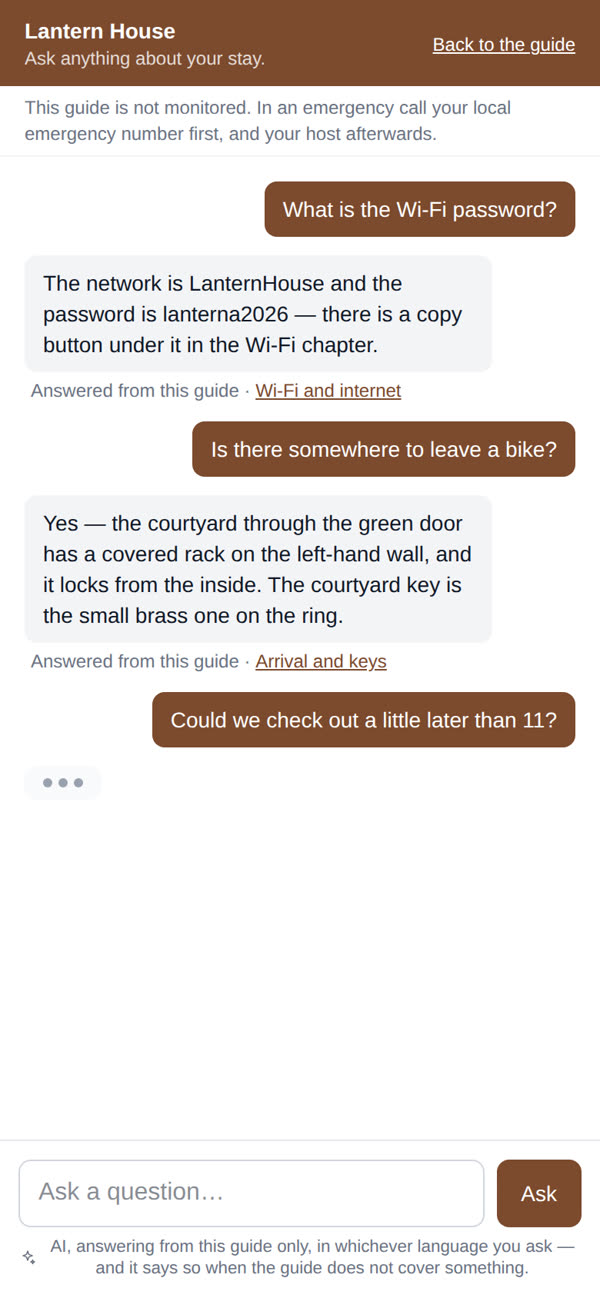
This is also the reason a guide a guest can ask beats one they have to read and translate. On a paid plan, or in the free plan’s first fourteen days, a guest types their question in their own language — Italian, Arabic, whatever it is — and the answer comes back in that language too, drawn only from what the host actually wrote, rather than the guest translating a static document by hand. Nothing about that depends on the host speaking a second language, and nothing in the answer is invented — it’s grounded in the guide itself. That is a claim to test rather than trust, and how to tell whether an AI is making things up gives eight questions to ask it. On a paid plan, the written guide itself can also carry a translated version, in Bosnian, Croatian, Serbian, English, German or Arabic, for guests who’d rather read than ask; details are on pricing.
You can see the guide from a guest’s side, and where they ask, on the sample guide; its chat gives one fixed reply rather than a real answer. The FAQ covers exactly what language the assistant answers in. If you’re writing the guide itself for the first time, the welcome book template and the check-in instructions template are both written plainly enough to translate well, on purpose. For which questions to answer first, see what guests ask most in a vacation rental.