A pre-arrival message is the email or platform message you send guests three to five days before check-in so they can plan the trip: what to bring, how to get there, parking, and anything you need from them. It is separate from the check-in instructions, which carry the door code and go out closer to arrival, so each message arrives when the guest can act on it.
What should a pre-arrival message say?
It should cover what to bring, how to get there, parking and anything you need from the guest, and say that the door code follows later. Copy this, fill in the brackets, and send it 3–5 days before arrival.
Hi [guest name], we're looking forward to hosting you on [arrival date]!

A few things to help you plan before you arrive:

WHAT TO BRING
[Anything genuinely worth packing for — beach towels not provided,
no air conditioning in a hot month, stairs with no lift, a pool that
needs its own towels. Skip this section entirely if nothing applies.]

GETTING HERE
[The realistic way most guests arrive — nearest airport or station, how
long the trip from there takes, whether a taxi or rental car makes more
sense. Not turn-by-turn directions yet — that goes in the check-in
message, closer to arrival.]

PARKING
[If it needs planning ahead — a permit to arrange, a gate code to
request in advance, a lot that fills up — say so now, while there's
still time to sort it out. If parking is simple, leave this out.]

ANYTHING WE NEED FROM YOU
[ID registration where local law requires it, a form to fill in before
arrival, a deposit to confirm — whatever is actually true for your
place and your country.]

WHAT'S NEXT
[The exact door code, Wi-Fi and step-by-step check-in instructions
follow in a separate message closer to your arrival date — say so
here, so nothing feels missing.]

See you soon!
That’s the whole message. Notice what isn’t in it: the lockbox code, the Wi-Fi password, the step-by-step for getting through the door. Those belong in a second message, sent closer to arrival — see the check-in instructions template for that one.
Why send two messages instead of one?
Because a guest still packing and a guest standing at your door need different things, and a single combined message serves neither well. The guest who is still packing doesn’t need the exact turn of a key yet, and will have long since lost the message by the time they do. The guest at the door doesn’t need travel logistics; they need the door open.
Splitting the two also fixes a smaller, real problem: a door code sent four days early sits in an inbox next to other messages, and by arrival day the guest is scrolling back through all of them trying to find the right one. A code sent when it’s actually needed doesn’t have that competition.
What belongs in a pre-arrival message, and what doesn’t?
Anything that helps a guest plan the trip belongs; anything they can only use at the door does not.
Belongs: anything that helps a guest plan the trip itself — what to pack, how to get from the airport, whether parking needs arranging ahead of time, any form or registration your country requires before arrival. This is information a guest benefits from having days early, not hours.
Doesn’t belong: the door code, the Wi-Fi password (where that goes instead), or a step-by-step for the lock. Sending those early doesn’t help — the guest can’t act on them yet — and it means the one message they actually need at the door is buried under everything else that came before it.
A genuine exception: if your check-in is entirely self-managed and there’s a real chance a guest won’t see a second message before arriving (an unreliable connection at the destination, an unusually long gap between messages), send the full check-in details early too, and say plainly that this is the complete set. The split above is a default, not a rule that overrides your judgment about a specific guest.
When should you send a pre-arrival message?
Send it three to five days before arrival: early enough to be useful — a guest can still adjust travel plans, book a rental car, or ask a question — and late enough that the message isn’t stale by the time they read it. Earlier than that and it competes with the booking confirmation for attention; later and it stops being a planning message and starts being an arrival one.
What comes after the pre-arrival message?
The check-in instructions, then answers during the stay, then checkout. Each has its own page: pre-arrival here, then check-in, then everything a guest asks while they’re staying — see what guests ask most in a vacation rental for that order — and finally checkout. If you’re writing all of it in one sitting rather than message by message, the full welcome book template covers the same ground as a single document. If the booking arrives in a language you don’t speak, what to translate first puts safety and getting in ahead of everything else.
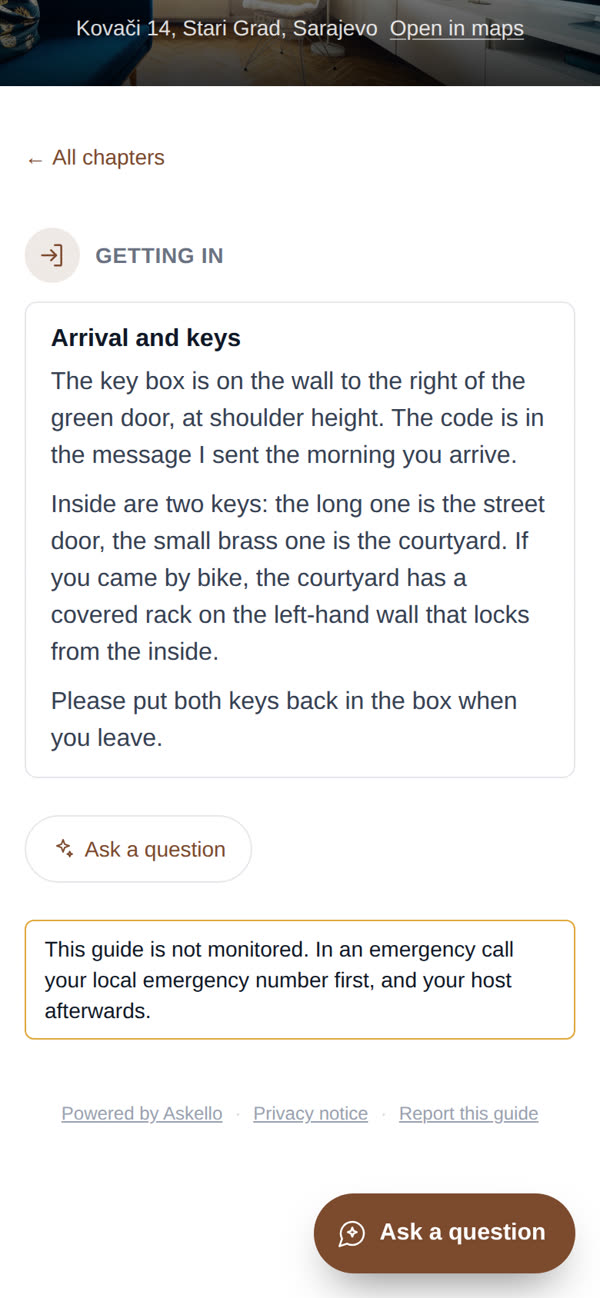
A pre-arrival message answers the questions a guest has before the trip; the questions that come up mid-stay need something they can open at the door. Askello turns your listing into a guest guide that guests reach by scanning a QR code or opening a link, with nothing to install, and on the paid plans an assistant answers their questions from that guide alone, in whichever language they ask. See it from the guest’s side on the sample guide, the FAQ covers how it works, and create your guide from your listing drafts a first version from what you’ve already published.
Questions hosts ask
Is a pre-arrival email the same as the check-in message? No. The pre-arrival message helps the guest plan the trip and goes out three to five days early; the check-in message carries the door code, Wi-Fi and the steps to get in, and goes out closer to arrival.
How many days before arrival should I send it? Three to five. Earlier, it competes with the booking confirmation; later, it becomes an arrival message.
What if the booking is made two days before arrival? Send one message with both parts, the planning details first and the check-in steps below them, and say that it is the complete set.
Should a holiday rental pre-arrival message ask for ID or registration? Only where local law requires it or your platform asks for it. Say what you need, why, and by when, and nothing more.