Good house rules for guests are short: eight rules or fewer, each one a plain instruction followed by its reason, covering quiet hours, who is staying, parties, smoking, pets, parking, rubbish and check-out. Below is a template you can copy, two filled-in examples, the variants for a flat, a house with a garden or pool, and a place with pets, and where the list needs to live so guests see it.
Which house rules should a vacation rental have?
Keep the rules that change what a guest does, and move everything else into the guide. Start with these eight:
- Quiet hours. A specific time, not “please be considerate”. “Quiet after 10pm” is a rule; “be respectful of noise” leaves the guest to decide what it means.
- Who is staying. How many guests, and whether visitors who are not on the booking may come, and until when.
- Parties and events. Say plainly whether they are allowed, once.
- Smoking. Where, if anywhere. Indoors needs to be unambiguous either way.
- Pets. Whether they are welcome, and what follows from a yes: extra cleaning, rooms or furniture that are off-limits.
- Parking. Where, and anything a guest would otherwise get wrong: a permit, a numbered bay, a street that tows.
- Rubbish. Which bin, which bag, which day, if your building or town makes this a real point of friction.
- Check-out. What leaving it tidy means in your place, and the time.
If your place needs a ninth, such as a pool, a shared courtyard or an owner living upstairs, add it. Lines like “please enjoy your stay” and “treat our home as your own” are not rules; cut them.
Is there a house rules template I can copy?
Yes. Copy the block below, replace every bracket with your own answer, and delete any rule you do not actually enforce.
HOUSE RULES: [property name]

Quiet after [10pm]. [The walls here carry sound, and the
neighbours are families.]

[N] guests, the ones on the booking. [Daytime visitors are fine;
overnight ones are not.]

No parties or events. [This is a flat in a building where people
live, not a venue.]

No smoking indoors, including [on the balcony with the door open /
at the windows]. [There is an ashtray by the ...]

Pets: [welcome / not this time]. [If welcome: not on the beds or
the sofa, please.]

Park [in bay N / in the garage at ...]. [The street outside is
permit-only and they do tow.]

Rubbish goes in [the bins at ...]: [general in the grey, glass in
the green]. Collection is [Tuesday morning].

Last morning: [leave the dishes in the machine and start it],
[keys back in the key box], door pulled shut, out by [10am].

If something breaks or stops working, message me. It is easier to
fix while you are still here.
Leave out fees, fines and deposits. What you may charge and how it is enforced depends on your country and your booking platform, so it belongs in your booking terms, not in the list a guest reads at the door.
What do filled-in house rules look like?
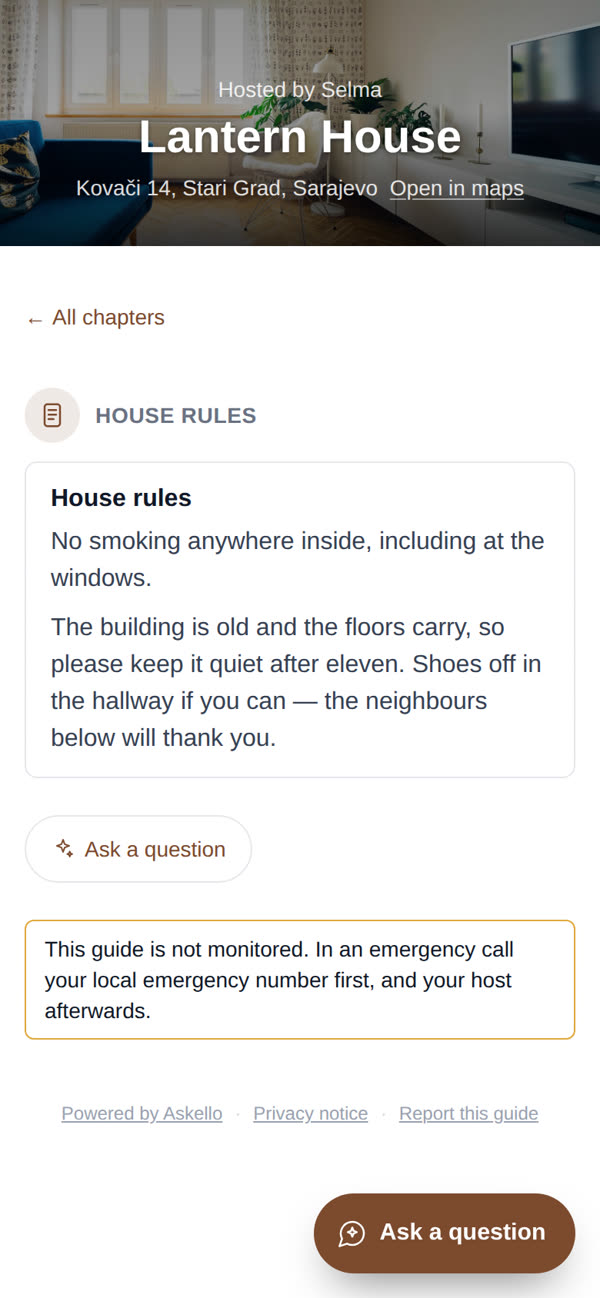
Filled-in house rules can be as short as two lines, each a rule with its reason in the same sentence, like these two from Askello’s sample guides, which you can open as a guest would: Lantern House in Sarajevo and Apartman Lanterna in Split. Each is two rules long, because each place needs only two; the Sarajevo one is shown with its checkout section, which the guide keeps separate.
Example 1: Lantern House, Kovači 14, Sarajevo
HOUSE RULES: Lantern House

No smoking anywhere inside, including at the windows.

The building is old and the floors carry, so please keep it quiet
after eleven. Shoes off in the hallway if you can — the neighbours
below will thank you.

Checkout: any time before eleven. Strip the beds if you have a
minute, leave the dishes in the machine and start it, put both
keys back in the box and spin the dial. That is all.
Parking is not a rule here: the lane outside is pedestrian-only from ten in the morning, which the guide explains in its own parking section, next to the garage two streets down.
Example 2: Apartman Lanterna, Šperun 12, Split
The Split sample is written in Croatian, for Croatian and regional guests:
KUĆNI RED: Apartman Lanterna

Pušenje nije dopušteno nigdje unutra, ni uz prozor.

Zgrada je stara i podovi prenose zvuk, pa vas molim za tišinu
nakon jedanaest. Ako možete, izujte se u hodniku — susjedi ispod
bit će vam zahvalni.
In English: no smoking anywhere inside, including at the window; the building is old and the floors carry sound, so quiet after eleven, and shoes off in the hallway if you can. Two rules, each with its reason in the same sentence.
How should house rules change for a flat, a house with a pool, or a place with pets?
Change the rules your kind of place makes different: the neighbours for a flat, the pool for a house, where pets may go:
- A flat in a building. Quiet hours and the neighbours carry most of the weight; add the stairwell, the lift, or the shared door if they cause trouble. The Sarajevo example is this case.
- A house with a garden or a pool. Add the pool: hours, no glass at the edge, children supervised, the gate shut. Move quiet hours outside too, because a terrace has no wall between you and the neighbours.
- Pets welcome. Say where they may not go (beds, sofa), where they may relieve themselves, and whether they may be left alone in the flat.
- Self check-out by key box or smart lock. The check-out line has to say where the keys go (back in the box, dial spun) or that the door locks itself, because nobody is there to ask. The checkout instructions template has the full message, with the key lines for each kind of lock.
How do I phrase a rule so guests read it?
Write the rule, then the reason, in one sentence each. Compare:
No noise after 10pm.
with
Quiet after 10pm: the walls here carry sound, and the neighbours are families.
The second tells the guest why the rule exists, and costs you one line. Where you can, phrase a rule as what to do rather than what not to do: “quiet after 10pm” gives a time, “no excessive noise” makes the guest guess where the line is.
Then read the list once as a guest would. Rewrite anything that sounds like a contract as a plain sentence a guest could act on. If some guests will read your rules through a translation app, keep each rule to one short sentence: short sentences translate more reliably, as the guide to hosting guests who don’t speak your language explains.
What should I do with the rules I cut?
File each cut line where the guest needs it, or delete it. “Do not put the wooden boards in the dishwasher” belongs next to the dishwasher in the how-things-work part of your welcome book. “The second key is for the building door” belongs in your check-in instructions. “The heating takes an hour” is an appliance note. Filed as rules, they read as a list of ways to get in trouble; filed where the guest is when they need them, they read as help.
Sort your current list into three piles: rules that change what a guest does, instructions for a specific moment, and lines that are neither. Delete the third pile.
Where should house rules appear?
Put the same short list in three places: the listing, so a guest can decide before booking; the pre-arrival message; and the guide the guest has open during the stay, the version they can still find at 11pm on the second night.
The Airbnb house manual guide covers what belongs in Airbnb’s house rules and what belongs in its house manual. The questions guests send most often, rules included, are in what guests ask most in a vacation rental.
Questions hosts ask
Are there sample house rules for guests I can copy? Yes: the template above, and the two filled-in examples from the Sarajevo and Split sample guides. Copy one, change the times and the reasons to your own, and delete what does not apply.
How many house rules should a vacation rental have? As many as change what a guest does: the template has eight, and both examples on this page have two.
Should house rules mention fines or a deposit? No. Put charges in your booking terms, where the platform and local law apply to them, and keep the list a guest reads to what they should do.
Where do house rules go in a welcome book? Third, after getting in and the Wi-Fi, the order the welcome book template uses. The welcome book template shows the full order.