A vacation rental welcome book answers the questions guests ask during a stay, in the order they ask them: how to get in, the Wi-Fi, the house rules, how things work, rubbish, check-out, emergencies, getting around, where to eat, what to do nearby, and the small print. Below is a template with those eleven sections, two filled-in example welcome books, and the lines to change for a key box, smart lock, intercom or meeting guests in person.
What should a vacation rental welcome book include?
Eleven sections: getting in, Wi-Fi, house rules, how things work, rubbish and recycling, check-out, emergencies, getting around, eating and drinking, things to do nearby, and the small print. Put them in that order, because it is the order a guest meets them in.
The rule for what goes inside each one: write down anything you have explained twice. A welcome book is not a brochure about your region; it is the list of answers you are tired of typing. If a guest has never asked it, it can wait. If two guests have asked it, it goes in tonight. For the order in which those questions arrive, see what guests ask most in a vacation rental.
Is there a welcome book template I can copy?
Yes: the eleven-section template below is free to copy into any document; fill in the brackets and you have the book. Each heading is explained further down.
GETTING IN
[The address as a maps app needs it · what the building looks like from the
street · where the key is and how the lock works, step by step, including what
to do when the code does not work the first time · floor, door, bell · parking]

WI-FI
[Network name and password, spelled so they cannot be misread · what to
restart if it drops]

HOUSE RULES
[Quiet hours · smoking · pets · parties · extra visitors]

HOW THINGS WORK
[Heating or air conditioning · hob or oven · washing machine · dishwasher ·
TV · coffee · hot water: one short paragraph each, the way you would say it]

RUBBISH AND RECYCLING
[Where the bins are · which bag goes where · collection days]

CHECK-OUT
[By what time · beds · dishes · keys · door]

EMERGENCIES AND SAFETY
[Fuse box · water stop-valve · fire extinguisher · first-aid kit · the local
emergency number · your number, and when it is fine to use it]

GETTING AROUND
[Airport or station · supermarket · pharmacy · the taxi or ride app locals use ·
the public transport a visitor would not guess]

EATING AND DRINKING
[Three to five places you would send a friend, one line each on why]

WORTH DOING NEARBY
[The handful of things a guest with one free afternoon should not miss]

THE SMALL PRINT
[Tourist tax · ID registration · the cleaner on longer stays · what to do if
something breaks]
What does a filled-in welcome book look like?
A filled-in welcome book reads like the host talking: the real address, where the key is and what to do with it, one short paragraph per section. Here are two, written from our sample guides; the places are made up, and each keeps only the sections its sample has.
Example 1: Lantern House, Kovači 14, Sarajevo
GETTING IN
Lantern House, Kovači 14, Stari Grad, Sarajevo. Check-in from 15:00.
The key box is on the wall to the right of the green door, at shoulder
height. The code is in the message I send the morning you arrive.
Inside are two keys: the long one is the street door, the small brass one
is the courtyard. If you came by bike, the courtyard has a covered rack on
the left-hand wall that locks from the inside.

PARKING
The lane outside is pedestrian-only from ten in the morning, so unload at
the door before then if you can. The public garage two streets down the
hill takes cards and charges by the hour; from there it is a four-minute
walk up.

WI-FI
Network: LanternHouse · Password: lanterna2026
If it drops, unplug the white box on the hallway shelf for ten seconds and
give it two minutes to come back. Nothing else needs restarting.

HOUSE RULES
No smoking anywhere inside, including at the windows. The building is old
and the floors carry, so please keep it quiet after eleven. Shoes off in
the hallway if you can.

HOW THINGS WORK
Oven: the left-hand dial. Turn it to the flame mark, hold it in for about
three seconds, then set the temperature.
Dishwasher tablets are under the sink. The coffee is in the cupboard above
the kettle and it is yours.
Radiators run on a timer, six to ten in the morning and four to eleven at
night; the dial in the hallway raises the whole flat by a couple of degrees.
Hot water takes about a minute to reach the shower.

CHECK-OUT
Any time before eleven. Strip the beds if you have a minute, leave the
dishes in the machine and start it, put both keys back in the box and spin
the dial. That is all.

EATING AND DRINKING
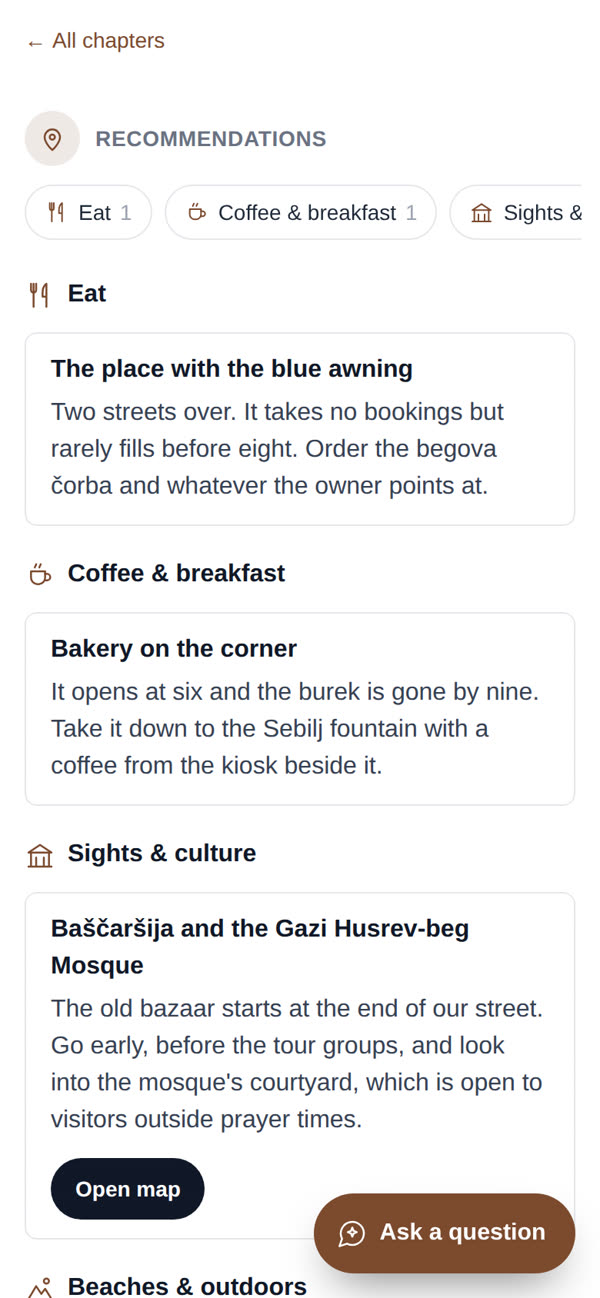
The bakery on the corner opens at six and the burek is gone by nine.
The place with the blue awning, two streets over: no bookings, rarely full
before eight. Order the begova čorba.

WORTH DOING NEARBY
Baščaršija starts at the end of our street: go early, before the tour
groups. The Yellow Fortress is twenty minutes uphill, best just before
sunset. Markale market is five minutes on foot; go before ten.
Example 2: Apartman Lanterna, Šperun 12, Split
GETTING IN
Apartman Lanterna, Šperun 12, 21000 Split. Check-in from 15:00.
The key box is on the wall to the right of the green door, at shoulder
height. The code is in the message I send the morning you arrive. The long
key opens the street door, the small brass one the courtyard.

PARKING
The street outside is a pedestrian zone from ten in the morning: unload at
the door before then. The public garage two streets down takes cards and
charges by the hour; it is a four-minute walk back up.

WI-FI
Network: ApartmanLanterna · Password: lanterna2026
If it drops, unplug the white box on the hallway shelf for ten seconds.

HOUSE RULES
No smoking inside, not even at the window. Quiet after eleven: the floors
carry sound to the neighbours below.

HOW THINGS WORK
Oven: left-hand dial to the flame mark, hold for three seconds, then set
the temperature. Radiators run six to ten and four to eleven; the hallway
dial raises the whole flat a few degrees.

CHECK-OUT
Any time before eleven. Beds stripped if you have a minute, dishwasher
started, both keys back in the box, dial spun.

EATING AND DRINKING
The konoba with the blue awning, two streets away: no bookings, rarely
full before eight. Order the black risotto and whatever fish the owner
points at.

WORTH DOING NEARBY
Diocletian's Palace: go in early through the Golden Gate and down into the
cellars. Marjan hill and Kašjuni beach: twenty minutes on foot to the steps
at the top of Varoš, then pine shade.
The Pazar market by the palace's east gate, before ten.

THE SMALL PRINT
Tourist tax is charged per person per night. I register every guest, so
please have each passport or ID card ready when you arrive.
The small print in the Split example is there because Croatia requires every guest to be registered in eVisitor, the national guest-registration system, and a host needs the guest’s documents to do it. Write whatever your own country requires, and link the official source rather than paraphrasing the law.
What goes in each section?
Each section answers one question a guest will otherwise send you. Write it for someone reading on a phone, in a place they have never been.
1. Getting in
The one section read under stress, on a phone, often at night, sometimes after a flight. Give the exact address written so a navigation app resolves it, what the building looks like from the street, where the key is and how the lock works step by step, what to do when the code does not work the first time, which floor and door, and a sentence about parking. The check-in instructions template is this section written as the message you send before arrival.
2. Wi-Fi
Network name and password, spelled out so they cannot be misread: say “the number one, not the letter L” if your password invites the confusion. Add what to restart if it drops. Put it early and make it copyable, and keep a printed copy in the flat too: the reason is in how to give guests the Wi-Fi password.
3. House rules
Short and honest: quiet hours, smoking, pets, parties, extra visitors. A guest cannot keep a rule they never saw, so put it where it cannot be missed, and give the reason when there is one (“the floors carry”). House rules guests actually read has the wording.
4. How things work
Cover whatever in your place needs explaining to a stranger: heating or air conditioning, the hob or oven, the washing machine, the dishwasher, the TV, the coffee, the hot water. One short paragraph each, written the way you would explain it standing in the room.
5. Rubbish and recycling
Where the bins are, which bag goes where, and collection days if guests need to act on them.
6. Check-out
What “leave it tidy” means to you, specifically: strip the beds or not, dishes where, keys where, door locked how, by what time. Tell guests what right looks like and they can do it. The checkout instructions template turns this section into a message you can send the morning they leave.
7. Emergencies and safety
Where the fuse box, water stop-valve, fire extinguisher and first-aid kit are. The local emergency number. Your number, and when it is fine to use it.
8. Getting around
How to get to and from the airport or station, where the nearest supermarket and pharmacy are, which taxi or ride app locals actually use, and anything about public transport a visitor would not guess.
9. Eating and drinking
Not a restaurant directory: three to five places you would actually send a friend, with one line each about why and what to order.
10. Worth doing nearby
Same rule. The beach, the trail, the market, the view: the handful of things a guest with one free afternoon should not miss, with the time of day to go.
11. The small print
Anything administrative: tourist tax, ID registration where the law requires it, when the cleaner comes on longer stays, what to do if something breaks.
How do I write the getting-in section for a key box, smart lock, intercom or in-person handover?
Change only the lines about the key, and keep the rest of the section in the same order. The address, the building, the floor and the parking do not change with the lock.
- Key box: where it is on the wall, at what height, how the code is entered, and whether the dial must be spun or the lid pushed shut after. Say where the code arrives (the message the morning of arrival, in the examples above), not the code itself, if the book is printed.
- Keypad or smart lock: which button wakes the pad, whether the code ends with a key such as the tick or the hash, how long to wait for the motor, and what to do if the pad stays dark (say where the spare key is kept, or which number to call).
- Intercom: which name or apartment number to press, what the buzzer sounds like, and which door opens: the street door, the stairwell, or both.
- In person: where to meet, how to let you know they have landed or are twenty minutes away, and what happens if they arrive later than planned.
Should the welcome book be printed, a PDF, or a link?
A link that opens on a phone, with the same text printed near the door. A printed binder is out of reach at the moment it is needed most, when the guest is outside with the key box; and a PDF has to be found and opened again before “boiler” can be searched.
That is the gap Askello fills: you paste your Airbnb link or your listing’s text, add what this template covers, and guests scan a QR code and read the guide on their phone, with no app to install. On the paid plans they can also ask it questions in their own language, and the answers come only from your words; what the guide does not cover lands on your list to answer once. If you would rather not fill in a document at all, create your guide from your listing: paste your Airbnb link, or the text of any listing, and a first draft of your guide is written from it. You can see the guest’s side on the sample guide.
Questions hosts ask
Are there vacation rental welcome book examples or samples I can copy? Yes: the two filled-in examples above, one for a flat in Sarajevo and one in Split. Copy either, replace the address, the key, the Wi-Fi and the places, and keep the order.
Is there a free welcome book template for a vacation rental? The template on this page is free to copy: eleven sections in brackets, in the order guests need them.
What is the difference between a welcome book and a house manual? They are the same thing under two names. Airbnb calls it a house manual; the Airbnb house manual guide covers where it appears for guests there.
How long should a vacation rental welcome book be? As long as the questions your guests actually ask, and no longer. Leave out any section that does not apply to your place. The two examples are short because their sample guides are.