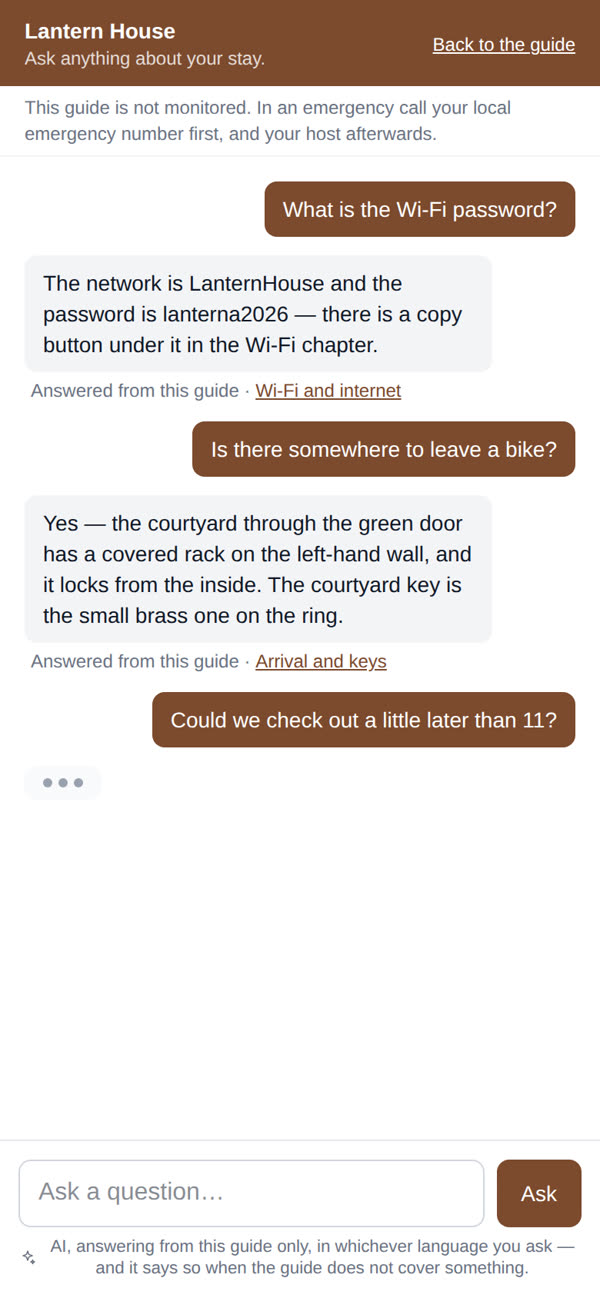
Vacation rental guests ask about the same few things, in the same order: how to get in, the Wi-Fi password, where to park, how the heating, shower and oven work, where to eat, and what to do at checkout. Answer each one once, with specifics, in a guide the guest can open on their phone at the moment the question occurs to them, and add every new question the first time it arrives.
Below are the questions grouped by when in the stay they come, a list to copy, answers filled in for one sample flat in Sarajevo and in Split, and a way to find the questions your own guide is missing.
Which questions do guests ask, and when?
Guests ask in the order of the stay, so group your answers the same way. Each stage has its own handful of questions:
- Before arrival: what time is check-in, how do I get in, where do I park, can I leave luggage early.
- On arrival: what is the Wi-Fi password, where are the keys, which door is ours.
- The first evening: how does the heating work, why is there no hot water, how do I turn on the oven, where do the bins go.
- During the stay: where should we eat, what is worth walking to, where is the nearest supermarket or market.
- The last morning: what time do we leave, what should we do with the beds and dishes, where do the keys go.
A guest standing outside your building at night will not scroll back through a three-week-old message thread. Put the answer one tap away, not in an old conversation.
Is there a list of guest questions I can copy?
Yes: the list below covers every stage of a stay. Copy it into your guide and answer each line with the specifics of your place: which door, which dial, which bin day.
GETTING IN
- Check-in time, and what to do if you arrive earlier or later
- Where the keys are: lockbox, smart lock, key handover or intercom
- What to do if the code or key does not work
- Which door, floor and flat number

WI-FI
- Network name and password, written so it cannot be misread
- What to do if the Wi-Fi drops

PARKING
- Where to park, what it costs, how far it is to walk

HOW THINGS WORK
- Heating or air conditioning, and any timer
- Hot water: how long it takes, where the switch is
- Oven, hob, dishwasher, washing machine
- Bins: which bin for what, and which day they are collected

HOUSE RULES
- Smoking, quiet hours, shoes, pets, guests

LOCAL TIPS
- Two or three places to eat, one coffee or breakfast place
- The nearest shop or market, and when it is open
- One thing worth walking to

CHECKOUT
- Checkout time
- Three to five tasks at most
- Where the keys go, and how to lock up
What do good answers look like, filled in?
A good answer gives the specific, not the policy. Here are three answers from the sample guide for Lantern House, a flat at Kovači 14 in Sarajevo’s old town:
How do I get in? The key box is on the wall to the right of the green door, at shoulder height. The code is in the message I sent the morning you arrive. Inside are two keys: the long one is the street door, the small brass one is the courtyard.
The Wi-Fi is not working. Unplug the white box on the hallway shelf for ten seconds and give it two minutes to come back.
Where do I park? The lane outside is pedestrian-only from ten in the morning, so unload at the door before then if you can. The public garage two streets down the hill takes cards and charges by the hour; from there it is a four-minute walk up.
The same flat, written for guests in Split as Apartman Lanterna on Šperun, answers the first-evening questions in a line or two each:
How does the oven work? The oven is the left-hand dial: turn it to the flame mark and hold it in for about three seconds, then set the temperature.
Why is the shower cold? Hot water takes about a minute to reach the shower.
The flat is cold. How does the heating work? The radiators are on a timer from six to ten in the morning and four to eleven at night. The dial in the hallway raises the whole flat by a couple of degrees.
Notice what each answer has in common: a place you can point at (the green door, the hallway shelf, the left-hand dial), an action, and what to do if it does not work.
How do the “getting in” answers change with the lock?
The question is always “how do I get in”, but the answer depends on the lock. Write the version that matches yours:
- Lockbox: where the box is, how the guest receives the code, which key opens what, and that both keys go back in the box at the end.
- Smart lock: when the code arrives and how long it works, which button to press after the code, and what to do if the battery is flat.
- In person: the time window you can meet, the number to message twenty minutes before arrival, and where to wait if you are late.
- Intercom: which name or number to press, which floor, and which door the buzzer opens.
The check-in instructions template has each of these written out in full.
Where should the answers live so guests find them?
In one link the guest gets before arrival and can reopen during the stay, with the Wi-Fi password also on paper inside the flat for a guest with no mobile data; the Wi-Fi password guide shows how to write it. Head each answer with the guest’s word for it: a guest who searches for “washing machine” will not find a section called “Laundry”.
How do I find the questions my guide is missing?
Write down every question a guest asks, the same day, even one you answered well. A guide feels finished the day you write it; guests show you what it is missing one stay at a time, and without a list you cannot tell a pattern from a one-off.
Questions reach you three ways, and only one of them lands in your inbox:
- Messages during the stay. The obvious source.
- Reviews. “Would have been nice to know the shower needs a minute to warm up” is the same signal as a question, only later.
- In person, at a key handover or checkout, where guests ask the basic things they would not bother to text.
Then decide what earns a place in the guide:
- Asked by two different guests: add it.
- Asked once, but about the flat itself (a light switch in an odd place, a door that sticks): add it, because the next guest meets the same switch.
- Asked once, about one booking (an extra night, a late checkout): answer it, leave it out.
The test for the last two: would the same question make sense from a different guest arriving on a different day? If yes, it belongs in the guide. Read the list once a week for your first few months, then once a month, and write each new section the day you add it.
If you would rather not keep the list by hand, Askello keeps it for you while its assistant is on (the paid plans, and the free plan’s first 14 days): when a guest asks something your guide does not cover, the question is added to a list of questions your guide could not answer, so you can write the answer once.
What should checkout and house rules answers say?
Say exactly what you want, in a short list. “Strip the beds if you have a minute, leave the dishes in the machine and start it, put both keys back in the box and spin the dial” tells a guest more than “please leave the flat as you found it”. The checkout instructions template has a version to copy, and house rules guests actually read does the same for rules.
Questions hosts ask
What is the question guests ask most often? Getting in and the Wi-Fi password are the two a guest needs first, so answer both before arrival, and put the Wi-Fi password on paper inside the flat as well.
What should I include in a guest FAQ for my rental? Getting in, Wi-Fi, parking, how the heating, hot water and appliances work, house rules, two or three local tips, and checkout. The list above covers each one.
How do I stop answering the same guest questions every stay? Write each answer once, with specifics, in a guide guests can reopen on their phone, send the link before arrival, and add every new question the first time it is asked.
Should local recommendations be a long list? No. Two or three places you would send a friend, each with one line on why and when to go, answer “what would a local do” better than a long list.
Where do I start if I have no guide at all? With the welcome book template, then add each question from the list above that your place needs.